Yesterday afternoon I made the 15-minute walk between our two campuses. Half way down the path, I met an agronomy student, a young woman named Fanny Mamani. ¿Cómo estás? I asked.
Un poco cansada -- A little tired, she responded -- I came from Caranavi yesterday.
How did you get here? I asked. Isn't there a blockade? Since Monday, farmers in Caranavi have been protesting a decision by the government to change the location of a planned citrus processing plant from their town to another town further down the road. All roads to Caranavi -- and the whole northeast of the region -- are blocked.
Fanny replied, Well, I went home to Caranavi to see my mother, and got trapped by the blockade. So I walked 8 hours to El Choro -- where the last road blockade is located -- and got a bus from there.
The blockades are sometimes violent: farmers throw rocks from above the road, or physically stop people from crossing. That a student would brave this amazes me -- and drives home how important this opportunity to study is for our students.
Thursday, April 29, 2010


Tuesday, April 27, 2010
Fiesta del Ayni

Our work at the College is possible only through the efforts of many, many people, contributions made according to each person's gifts and means. We celebrate these many contributions with the Fiesta del Ayni, the Carmen Pampa Fund's annual fund-raising get-together.
This year, the event is on May 6th from 6-9 p.m. at St. Catherine University in St. Paul, Minnesota. The inspiring Sister Damon Nolan, foundress of the College, will be there, as well as our current Director General, Father Freddy del Villar.
Two students from the College will also be there -- and like Gonzalo last year, will do some traditional Bolivian dances.
For more information or to RSVP, please call Carmen Pampa Fund's office at 651.641.1588 or e-mail at info@carmenpampafund.org.
Another first
Two weeks ago, we had another first at the College: the first student to graduate with the new graduation option, a business plan.
Most students at the College do a research project for their graduation requirement, but we found that students who wanted to start a business were at a disadvantage. Two years ago we asked Catholic University of Bolivia (our academic home) for permission to graduate students who write and defend a business plan. And our request was granted.
Fernando Salazar is the first of these students. He wrote a business plan for a butterfly farm focused on producing chrysalis and mounted specimens for sale in Bolivia, and internationally on the Internet.
Graduates that become motors for local economies, and graduates that create jobs instead of looking for jobs, is one of the reasons we are here. Congratulations to Fernando, and may many more students with these goals pass through our doors.

Photo: Proposed design for new graduate Fernando's laboratory and butterfly house. Though the main goal is producing butterflies for sale, the business will also be open to tourists.
Most students at the College do a research project for their graduation requirement, but we found that students who wanted to start a business were at a disadvantage. Two years ago we asked Catholic University of Bolivia (our academic home) for permission to graduate students who write and defend a business plan. And our request was granted.
Fernando Salazar is the first of these students. He wrote a business plan for a butterfly farm focused on producing chrysalis and mounted specimens for sale in Bolivia, and internationally on the Internet.
Graduates that become motors for local economies, and graduates that create jobs instead of looking for jobs, is one of the reasons we are here. Congratulations to Fernando, and may many more students with these goals pass through our doors.

Photo: Proposed design for new graduate Fernando's laboratory and butterfly house. Though the main goal is producing butterflies for sale, the business will also be open to tourists.
Friday, April 23, 2010
First grad
Bolivia used to have a shortage of teachers in rural areas, so gifted high school graduates were invited to teach in rural schools. As more students graduated from Bolivia's teaching colleges, these maestros interinos were asked to get their teaching certificates or leave the profession.
In 2003, the College in Carmen Pampa started offering an elementary school teaching degree to these maestros interinos, holding classes on weekends in the town of Caranavi, about 3 hours from the College. Last weekend, the first of these students completed her research project, the last requirement of the program.
This student was Sandra Barreto. She wanted her degree to be able to keep teaching while her husband drives a taxi, and they raise their daughter together. She studied how deaf students are handled in Caranavi's public elementary schools -- and found that school principals and teachers there were generally unfamiliar with idea of mainstreaming deaf students in classrooms with their peers, and also unequipped to make these accommodations.
"Deaf students -- and students with disabilities in general -- are marginalized in our rural schools. Teachers do not know how to integrate them into their classrooms," she notes. "There is also a great prejudice in society, based on the surprisingly common belief that God punishes parents by giving them children with special needs. And since parents are the main advocates in these situations, their children are often kept out of sight at home, or sent to a special program sponsored by the mayor's office."
This is not enough, she explains. According to Bolivian law, and experiences here and in other countries, mainstreaming children with special needs is beneficial in many cases. Sandra is sharing her results with the school system in Caranavi, raising awareness of this issue, and making practical suggestions about how to change the current system, like more teacher training, and working with parents with children with special needs. She is well placed to do this at her current job with an local organization that teaches parenting skills to mothers and fathers in Caranavi.
Meanwhile, we will celebrate her success, a trail-blazer for her classmates as the first graduate from this special program at the College. Congratulations, Sandra!

In 2003, the College in Carmen Pampa started offering an elementary school teaching degree to these maestros interinos, holding classes on weekends in the town of Caranavi, about 3 hours from the College. Last weekend, the first of these students completed her research project, the last requirement of the program.
This student was Sandra Barreto. She wanted her degree to be able to keep teaching while her husband drives a taxi, and they raise their daughter together. She studied how deaf students are handled in Caranavi's public elementary schools -- and found that school principals and teachers there were generally unfamiliar with idea of mainstreaming deaf students in classrooms with their peers, and also unequipped to make these accommodations.
"Deaf students -- and students with disabilities in general -- are marginalized in our rural schools. Teachers do not know how to integrate them into their classrooms," she notes. "There is also a great prejudice in society, based on the surprisingly common belief that God punishes parents by giving them children with special needs. And since parents are the main advocates in these situations, their children are often kept out of sight at home, or sent to a special program sponsored by the mayor's office."
This is not enough, she explains. According to Bolivian law, and experiences here and in other countries, mainstreaming children with special needs is beneficial in many cases. Sandra is sharing her results with the school system in Caranavi, raising awareness of this issue, and making practical suggestions about how to change the current system, like more teacher training, and working with parents with children with special needs. She is well placed to do this at her current job with an local organization that teaches parenting skills to mothers and fathers in Caranavi.
Meanwhile, we will celebrate her success, a trail-blazer for her classmates as the first graduate from this special program at the College. Congratulations, Sandra!

Friday, April 16, 2010
Carmen Pampa
A student named Carmen Pampa, from our community of the same name, defended her senior project today, the fifth in the Education department. She studied how elementary students understand their environment.
Carmen's father was a librarian at the College, and died in 2003 of tuberculosis. Her mother, who turned to raising chickens with her sons who study vet/animal science at the College, served up a delicious chicken dinner to commemorate her success.
Here is our latest success with her two children. ¡Felicidades, Carmen!

Carmen's father was a librarian at the College, and died in 2003 of tuberculosis. Her mother, who turned to raising chickens with her sons who study vet/animal science at the College, served up a delicious chicken dinner to commemorate her success.
Here is our latest success with her two children. ¡Felicidades, Carmen!

Thursday, April 15, 2010
The Carmen Pampa Fund
This week, two members of the Carmen Pampa Fund Board of Directors, Ann Leahy and Tara Nolan, were at the College to do collaborative planning for the next six months, and share our respective successes and challenges. With Ann and Tara's energy and good will, and the spirit present at the College, I think that there is no challenge to great.
And here we are: (L to R) your truly, Director of Education Andrés Pardo, Academic Secretary Manuela Urbina, CPF Board President Ann Leahy, Ex Bolivian Ambassador Jorge Crespo, the Bishop of Coroico Juan Vargas, CPF liaison Sarah Mechtenberg, Religious Education Director Jean Morrissey, College Director General Father Freddy del Villar and CPF Board member Tara Nolan.

And here we are: (L to R) your truly, Director of Education Andrés Pardo, Academic Secretary Manuela Urbina, CPF Board President Ann Leahy, Ex Bolivian Ambassador Jorge Crespo, the Bishop of Coroico Juan Vargas, CPF liaison Sarah Mechtenberg, Religious Education Director Jean Morrissey, College Director General Father Freddy del Villar and CPF Board member Tara Nolan.

Veronica Calles
Coca is a plant with a long and complex history. Considered the mother of all plants, it has many traditional uses among indigenous people of the Andes. It wasn't until cocaine was isolated from the leaves in the mid 1800s that it developed its current reputation as a narcotic -- and when used traditionally, it is not considered a vice. It still has an important place in Andean society.
To grow coca, the soil is inverted, turning the rich topsoil under, and forming hard terraces with the clay subsoil. The coca is planted into these terraces, and produces harvestable leaves for about 30 years. Then the land is abandoned: this process leaves the soil unfertile, even for forrage grasses.
Veronica Calles, an agronomy student at the College, planted an abandoned coca field with a mix of ground covers, crops and local tree species to see whether the land could be recovered for use -- and found that leguminous cover crops and local tree species adapted successfully -- and the crops, well, not so much.
The project was supported by a USDA-funded collaboration with South Dakota State University, Sisseton Wapheton College and Nebraska Indian Community College, directed by Dr. Diane Rickerl, one of the College's ambassadors.
Her graduation project was well received, and Veronica last Thursday became the latest graduate at the College. Congratulations, Veronica!

To grow coca, the soil is inverted, turning the rich topsoil under, and forming hard terraces with the clay subsoil. The coca is planted into these terraces, and produces harvestable leaves for about 30 years. Then the land is abandoned: this process leaves the soil unfertile, even for forrage grasses.
Veronica Calles, an agronomy student at the College, planted an abandoned coca field with a mix of ground covers, crops and local tree species to see whether the land could be recovered for use -- and found that leguminous cover crops and local tree species adapted successfully -- and the crops, well, not so much.
The project was supported by a USDA-funded collaboration with South Dakota State University, Sisseton Wapheton College and Nebraska Indian Community College, directed by Dr. Diane Rickerl, one of the College's ambassadors.
Her graduation project was well received, and Veronica last Thursday became the latest graduate at the College. Congratulations, Veronica!

Thursday, April 08, 2010
Sarah Purcell joined us in Carmen Pampa as a recent graduate in international political economy from the University of California at Berkeley. She is currently collaborating with the student-run food cooperatives at the College*, intending to improve campus-wide nutrition through various approaches. She explains
While this increase in production and increase in collaboration is in the works, Sarah aims to organize the purchase of dry staples such as rice and sugar in La Paz which would save money -- and this money could then be spent on supplementing student diets with otherwise limited foods. She notes, though, that "change takes a considerable amount of work, and most importantly, time, even when attempted on a small scale."
Sarah hopes to use her experience at the UAC-Carmen Pampa to strengthen the unintegrated local food systems in the United States that are now bounded by class constraints. Her approach to these food systems would be through city planning, where she finds special interest in policy that could help with the integration of community gardens into cities and grocery stores into low income neighborhoods.
Unfortunately, she will be moving on in the next few weeks. Thank you, Sarah, for your work here at the College -- and we wish you much success in the future!

____________________
* The students pay about $20 a month to participate in the cooperatives, and that is subsidized by a generous donation from the Carmen Pampa Fund, and additional support from Cross International.
A long-term yet attainable goal would be the integration of the campus's organic vegetable garden into the food cooperative, making it the primary source of fresh food for the students. A similar approach, the farm to table or local food movement, is gaining force in the United States at this time, but is unfortunately largely restricted to a privileged class. The College, on the other hand, created for underprivileged students, has the potential to accomplish this full circle of food production on its very own campus. As it is, every student must contribute four hours per week to community service, so much of their time is already spent in the garden. Furthermore, most of the students on campus are from farm families themselves, so this connection to the earth and know-how already exists.
While this increase in production and increase in collaboration is in the works, Sarah aims to organize the purchase of dry staples such as rice and sugar in La Paz which would save money -- and this money could then be spent on supplementing student diets with otherwise limited foods. She notes, though, that "change takes a considerable amount of work, and most importantly, time, even when attempted on a small scale."
Sarah hopes to use her experience at the UAC-Carmen Pampa to strengthen the unintegrated local food systems in the United States that are now bounded by class constraints. Her approach to these food systems would be through city planning, where she finds special interest in policy that could help with the integration of community gardens into cities and grocery stores into low income neighborhoods.
Unfortunately, she will be moving on in the next few weeks. Thank you, Sarah, for your work here at the College -- and we wish you much success in the future!

____________________
* The students pay about $20 a month to participate in the cooperatives, and that is subsidized by a generous donation from the Carmen Pampa Fund, and additional support from Cross International.
Sunday, April 04, 2010
Easter 2010
Here are some pictures from our Easter here in Carmen Pampa.
Here is Father Freddy blessing palms on Palm Sunday.

The students did the passion play -- and a student named Jesús played Jesus.

A crowd of people from the congregation -- kids, mostly -- stood and followed Jesus as he carried the cross around the church. They were laughing and whispering and taking pictures and carrying on, which I thought was a little rude. Then Fr. Freddy said during his homily that the real crucifixion was like that, too: a spectacle, with people crowding around and talking and the like. It gave the story a new meaning for me.

At the Thursday night mass, Fr. Israel washed the feet of some church members, in remembrance of the Last Supper.

Friday we did the Way of the Cross.

Last night was the Easter Vigil mass. It starts out outside at the fire.

(This picture is from Joel Vaughn. He and his wife, Lynn Myrick, are here contemplating the College as a possible home for the next 3 years as Franciscan Mission Service missioners.)
Happy Easter to all! You are in our prayers here in Carmen Pampa.
Here is Father Freddy blessing palms on Palm Sunday.

The students did the passion play -- and a student named Jesús played Jesus.

A crowd of people from the congregation -- kids, mostly -- stood and followed Jesus as he carried the cross around the church. They were laughing and whispering and taking pictures and carrying on, which I thought was a little rude. Then Fr. Freddy said during his homily that the real crucifixion was like that, too: a spectacle, with people crowding around and talking and the like. It gave the story a new meaning for me.

At the Thursday night mass, Fr. Israel washed the feet of some church members, in remembrance of the Last Supper.

Friday we did the Way of the Cross.

Last night was the Easter Vigil mass. It starts out outside at the fire.

(This picture is from Joel Vaughn. He and his wife, Lynn Myrick, are here contemplating the College as a possible home for the next 3 years as Franciscan Mission Service missioners.)
Happy Easter to all! You are in our prayers here in Carmen Pampa.
Sunday, March 21, 2010
Kyle Piispanen
Rural Andean Bolivia is made up of small-scale farmers that feed large urban populations with poor access to markets, political instability, no mechanized equipment, and in altitudes of up to 13000 feet -- or more. Kyle Piispanen came to study this phenomenon as a graduate student in Applied Anthropology at Oregon State University, and is sharing his ecologist skills by teaching a tropical ecology at the College. Kyle writes:
“Ecology is the interdisciplinary scientific study of organisms and their interactions with the environment. In ecology we use the ecosystem as a unit of study, and in class we find ourselves in the field measuring populations, writing in our journals, thoughtfully stepping from one ecosystem to the next. It is becoming apparent that a rapid response to the global crisis confronting an ever-shrinking biological diversity will be necessary.
“Ecology has become a hot topic here because Bolivia is among the most biodiverse countries in the world. Recently it was announced that the country will host a meeting initiated by President Evo Morales called the First World Conference of People on Climate Change and the Rights of Mother Earth. The results of this conference are yet unknown, but it demonstrates a move in the Morales government towards recognition of critical issues in conservation and environmental health.
“I believe that students with a good background in ecology will help to guide society toward the conservation natural systems, and toward sustainable management of environmental resources. It is also important to integrate ecological knowledge into agriculture and ecosystem restoration. Students often describe ecosystems and biodiversity in Bolivia in terms of pisos ecológicos (ecological zones). Bolivia is known for 5 distinct pisos ecológicos: Puna, Altiplano, Valles, Yungas and the Lowlands. When one travels to Carmen Pampa from La Paz one passes through all of Bolivia’s distinct pisos, with the exception of the Lowlands, in less than 100 km!

Kyle in the classroom.
“Many different civilizations have worked in these ecological zones to develop a great diversity of food. The Yungas is an incredibly diverse and important zone itself. The Yungas forests that surround us are extremely diverse, ranging from moist lowland forest to evergreen montane forest and cloud forests. The steep valley walls are where people carve out their agricultural lands. This extremely rugged and varied environment contributes to the ecological diversity and richness. There are high levels of biodiversity and unique species throughout the Yungas regions. Unfortunately forest in this area is being lost due to the intensification of agriculture and increasing demands from the world’s cities.
“The students here at the College are introduced to concepts that are becoming increasingly important, and many of them have first-hand experience. They have experienced the many uses of native forest, the effects of contamination and conservation, and the consequences of population growth. These topics are especially relevant in the agronomy department: the futures of agriculture and food security are directly related to these issues.
“Saint Francis was an early ecologist and naturalist, observing animals, writing about them with affection, and recognizing their importance. Student come to class with a combination of direct experience in the field and a respect cultivated through the teachings of Saint Francis. They understand the natural environment, they know plant and animal names, and they have seen population dynamics in action in agricultural pests and diseases.
“By applying concepts of ecology to agriculture, we can produce food that is healthier, and conserve the natural environment for the important services it provides, services that help maintain life on this planet. It is my hope that these students will begin to learn how to make agrarian environments more livable, integrating ecology with food production; and the youth of Bolivia will start to return to rural areas for a better quality of life while contributing to food production. My students are asked to do a research project on a topic of ecology that interests them, and students have chosen topics as diverse as contamination of water, deforestation, and the introduction of exotic species. Students have demonstrated a high level of commitment to working towards resolving environmental issues that rural areas are facing.

Ecology student José Luis Chipana counts beans in a biodiversity exercise.
“Farmers are often the people most aware of the environmental changes. They are also aware of a need for a combination of environmentally sound food production and conservation. At Carmen Pampa, by empowering young farmers as future community leaders, I am hopeful that these leaders will bring thoughtful consideration and positive change to their communities.”
We are grateful for Kyle’s presence here, for his contributions to the College, his research that will lead to a greater understanding of how food is produced and used, and the spirit of unity and knowledge that he brings.
“Ecology is the interdisciplinary scientific study of organisms and their interactions with the environment. In ecology we use the ecosystem as a unit of study, and in class we find ourselves in the field measuring populations, writing in our journals, thoughtfully stepping from one ecosystem to the next. It is becoming apparent that a rapid response to the global crisis confronting an ever-shrinking biological diversity will be necessary.
“Ecology has become a hot topic here because Bolivia is among the most biodiverse countries in the world. Recently it was announced that the country will host a meeting initiated by President Evo Morales called the First World Conference of People on Climate Change and the Rights of Mother Earth. The results of this conference are yet unknown, but it demonstrates a move in the Morales government towards recognition of critical issues in conservation and environmental health.
“I believe that students with a good background in ecology will help to guide society toward the conservation natural systems, and toward sustainable management of environmental resources. It is also important to integrate ecological knowledge into agriculture and ecosystem restoration. Students often describe ecosystems and biodiversity in Bolivia in terms of pisos ecológicos (ecological zones). Bolivia is known for 5 distinct pisos ecológicos: Puna, Altiplano, Valles, Yungas and the Lowlands. When one travels to Carmen Pampa from La Paz one passes through all of Bolivia’s distinct pisos, with the exception of the Lowlands, in less than 100 km!

Kyle in the classroom.
“Many different civilizations have worked in these ecological zones to develop a great diversity of food. The Yungas is an incredibly diverse and important zone itself. The Yungas forests that surround us are extremely diverse, ranging from moist lowland forest to evergreen montane forest and cloud forests. The steep valley walls are where people carve out their agricultural lands. This extremely rugged and varied environment contributes to the ecological diversity and richness. There are high levels of biodiversity and unique species throughout the Yungas regions. Unfortunately forest in this area is being lost due to the intensification of agriculture and increasing demands from the world’s cities.
“The students here at the College are introduced to concepts that are becoming increasingly important, and many of them have first-hand experience. They have experienced the many uses of native forest, the effects of contamination and conservation, and the consequences of population growth. These topics are especially relevant in the agronomy department: the futures of agriculture and food security are directly related to these issues.
“Saint Francis was an early ecologist and naturalist, observing animals, writing about them with affection, and recognizing their importance. Student come to class with a combination of direct experience in the field and a respect cultivated through the teachings of Saint Francis. They understand the natural environment, they know plant and animal names, and they have seen population dynamics in action in agricultural pests and diseases.
“By applying concepts of ecology to agriculture, we can produce food that is healthier, and conserve the natural environment for the important services it provides, services that help maintain life on this planet. It is my hope that these students will begin to learn how to make agrarian environments more livable, integrating ecology with food production; and the youth of Bolivia will start to return to rural areas for a better quality of life while contributing to food production. My students are asked to do a research project on a topic of ecology that interests them, and students have chosen topics as diverse as contamination of water, deforestation, and the introduction of exotic species. Students have demonstrated a high level of commitment to working towards resolving environmental issues that rural areas are facing.

Ecology student José Luis Chipana counts beans in a biodiversity exercise.
“Farmers are often the people most aware of the environmental changes. They are also aware of a need for a combination of environmentally sound food production and conservation. At Carmen Pampa, by empowering young farmers as future community leaders, I am hopeful that these leaders will bring thoughtful consideration and positive change to their communities.”
We are grateful for Kyle’s presence here, for his contributions to the College, his research that will lead to a greater understanding of how food is produced and used, and the spirit of unity and knowledge that he brings.
Saturday, March 20, 2010
Anniversary of nursing department
Yesterday was the anniversary of the nursing department -- and it was incredible to see all of the young women and men in their "hospital whites"! It was a beautiful day, with a mass and a toast to these amazing young people, followed by a dance on the basketball court. Congratulations to these exceptional young women and men.
Here students prepare for the anniversary mass.

Two students with their family members.


Lidia Cuevas, the Director of the Nursing program, speaks to the College, with fifth semester student Hilarion by her side.

Donato Monrroy was recognized for his over fifteen years of service to the College.

Here students prepare for the anniversary mass.

Two students with their family members.


Lidia Cuevas, the Director of the Nursing program, speaks to the College, with fifth semester student Hilarion by her side.

Donato Monrroy was recognized for his over fifteen years of service to the College.

Sonia Moy
One of the students that I supervised, Sonia Moy, graduated yesterday -- she studied the life cycles of two butterflies, Mechanitis lysimnia elisa (Lysimnia clearwing)and Phoebis philea philea (orange-barred sulphur). These species are common in the area, and of commercial value. The project benefited the Nayriri Butterfly house, community-run project at the end of the Inca Trail near the College. She got a score of 86%, considered distinguished!

Photo:Sonia with her senior research project defense committee.

Photo:Sonia with her senior research project defense committee.
Monday, March 15, 2010
Ramiro and Juan Pedro
Saturday was the day to see students successfully defend their graduation projects.
First was Ramiro, the third education EVER to finish his degree. He worked with elementary students in Guanay, his home town 6 hours from the College, to see how students understood garbage and what happens to it -- and he found that they have a LOT to learn.

Photo: Ramiro with his defense committee.
Juan Pedro studied a family of beetles, some of which eat other insects, possibly crop pests. He found that the populations of these beetles has some species in common between crop land and forest, and some distinct. It shows that the forest is a possible resevoir for beneficial beetles.

Photo: Here is Juan Pedro talking a sample from an insect trap.
Juan Pedro was working for the Benson Institute on the Altiplano, helping farmers build underground greenhouses (I wrote about that here).
First was Ramiro, the third education EVER to finish his degree. He worked with elementary students in Guanay, his home town 6 hours from the College, to see how students understood garbage and what happens to it -- and he found that they have a LOT to learn.

Photo: Ramiro with his defense committee.
Juan Pedro studied a family of beetles, some of which eat other insects, possibly crop pests. He found that the populations of these beetles has some species in common between crop land and forest, and some distinct. It shows that the forest is a possible resevoir for beneficial beetles.

Photo: Here is Juan Pedro talking a sample from an insect trap.
Juan Pedro was working for the Benson Institute on the Altiplano, helping farmers build underground greenhouses (I wrote about that here).
Friday, March 12, 2010
Dani and Victor
Two more grads! Yesterday was vet student Dani Chambilla, the sister of graduate Rosa and tourism student Guido. She looked at different methods of measuring bacterial contamination of milk from udder infections (mastitis), and found that the California Mastitis Test was reliable and easy for farmers to use.

Photo:Dani with her defense committee and her two children.
Today was education student Juan Victor Ajllahuanca, who worked at the elementary school where he himself studied, examining how students learn math in third grade. He found that students had more problems with multiplication than with division, because it uses more steps (lots of carrying numbers into the next column, something less common with basic division done at that level). The teacher in that classroom was grateful for his observations, and his help with the class when he wasn't doing his research.
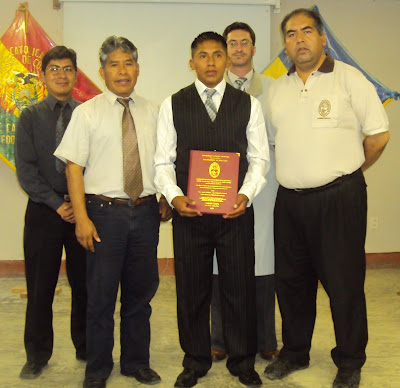
Photo:Juan Victor and his defense committee.
Congratulation to these two young new grads!

Photo:Dani with her defense committee and her two children.
Today was education student Juan Victor Ajllahuanca, who worked at the elementary school where he himself studied, examining how students learn math in third grade. He found that students had more problems with multiplication than with division, because it uses more steps (lots of carrying numbers into the next column, something less common with basic division done at that level). The teacher in that classroom was grateful for his observations, and his help with the class when he wasn't doing his research.

Photo:Juan Victor and his defense committee.
Congratulation to these two young new grads!
Wednesday, March 10, 2010
Sistema Plurinacional de Certificacion de Competencias
In December of 2008, President Evo Morales established the National Service of Competency Certification. Under the supervision of the Ministry of Education, this entity gives certificates to workers recognizing outstanding skills gained in the School of Life.
This weekend, a graduate of the College, Miguel Ángel Sánchez, stopped by the house, and explained that he and another four graduates are heading up the section that certifies farmers (and ranchers) in Bolivia. "This is a huge help for rural people," he explained, "because it gives them easier access to funds from the government's rural aid program."
The process requires that farmers apply at a government office, then have an interview with a certifier. The last step is a field evaluation where the certifier evaluates whether the person has the base of practical knowledge that is expected of a successful farmer.
"The certification can also be used for credit for a higher degree," Miguel told me. "A lot of older farmers are taking advantage of it. It is an outward sign that traditional knowledge is appreciated and valued." That is something in a country where as recently as 1952 farmers were considered unintelligent, good only for hard labor as indentured servants under the hacienda system.
It is sometimes difficult for students to find work in the place they were born, so many look for opportunities that impact their communities in other ways. These graduates are impacting rural areas by granting certificates -- and the means to a higher quality of life -- to community members like their parents and grandparents. Others with with micro-financing banks that get capital into the hands of enterprising farmers. Yet others work with NGOs that empower rural people. The spirit of our mission lives in these young people, and it inspires hope.
This weekend, a graduate of the College, Miguel Ángel Sánchez, stopped by the house, and explained that he and another four graduates are heading up the section that certifies farmers (and ranchers) in Bolivia. "This is a huge help for rural people," he explained, "because it gives them easier access to funds from the government's rural aid program."
The process requires that farmers apply at a government office, then have an interview with a certifier. The last step is a field evaluation where the certifier evaluates whether the person has the base of practical knowledge that is expected of a successful farmer.
"The certification can also be used for credit for a higher degree," Miguel told me. "A lot of older farmers are taking advantage of it. It is an outward sign that traditional knowledge is appreciated and valued." That is something in a country where as recently as 1952 farmers were considered unintelligent, good only for hard labor as indentured servants under the hacienda system.
It is sometimes difficult for students to find work in the place they were born, so many look for opportunities that impact their communities in other ways. These graduates are impacting rural areas by granting certificates -- and the means to a higher quality of life -- to community members like their parents and grandparents. Others with with micro-financing banks that get capital into the hands of enterprising farmers. Yet others work with NGOs that empower rural people. The spirit of our mission lives in these young people, and it inspires hope.
Wednesday, March 03, 2010
Forrages and Lentils
Friday, student Joel Bautista successfully defended his graduation project about the adaptation of different forrages to the local ecosystem. He tried out five species suggested by our collaborators at Brigham Young University, and found that weeping lovegrass (Eragrostis curvula) adapted well to our environment, and that this species could be cultivated to feed cattle, or even dry and sell as hay to the Bolivian Altiplano in their dry season.

Photo: Joel signs the defense document, with his mother, father and aunt in the background.
Yesterday, another agronomy student, Silvia Sevillanos, presented her research project about the adaptation of lentils to the land around Carmen Pampa. Of the four varieties that she planted, French Green was the best producer. Lentils are great soil improvers, full of protein, and cook much quicker than most legumes. This variety will become part of the university's cache of plants that both improve food security and permit greater economic stability.

Photo: Silvia with her son and husband, also soon to graduate.

Photo: Joel signs the defense document, with his mother, father and aunt in the background.
Yesterday, another agronomy student, Silvia Sevillanos, presented her research project about the adaptation of lentils to the land around Carmen Pampa. Of the four varieties that she planted, French Green was the best producer. Lentils are great soil improvers, full of protein, and cook much quicker than most legumes. This variety will become part of the university's cache of plants that both improve food security and permit greater economic stability.

Photo: Silvia with her son and husband, also soon to graduate.
Friday, February 19, 2010
Carnaval and Ash Wednesday
This week was a special week for Bolivia. A mix of indigenous Andean and Catholic traditions make the days leading up to Ash Wednesday -- know here are Carnavales -- a time of giving thanks to God and God's many manifestations. In and around Carmen Pampa, people decorate their houses with streamers and confetti, set off fire crackers and sprinkle alcohol in thanks to the Virgin (conceived as Pachamama, the Mother Earth), the saints (manifest in spirit guides called Achachilas) and God on High, known in Inti, the sun.
Sister Helena invited us to Cochuna where the Missionary Franciscan Sisters of the Immaculate Conception run a boarding house for rural students. With the help of the boarders, Sister Helena runs a farm that feeds the students and generates income to pay for other housing costs. The Bishop of Coroico, Monseignor Juan Vargas, blessed the school and the farm.

Photo: Bishop Vargas sprinkles holy water on the farm's new tractor as Father Freddy looks on.
Later, with the help of the students, we blessed the College's dormitories and classrooms.
Wednesday Father Freddy lead the Ash Wednesday mass on Campus Leahy, and later Father Eulogio on Campus Manning. Both reminded the students that Lent is a time of reflection on forgiveness. There is a saying around here: Pueblo chico, infierno grande ("Small town, big hell"). "We need to live together as brothers and sisters, with peace and understanding," Father Freddy reminded us. "It is not easy: we come from all different places, with distinct viewpoints and customs. But there is no other option. If you do not learn this now, you will have difficulties your whole life long."

Photo: Father Freddy places ashes on the forehead of agronomy student Janet Ramírez.

Photo: Father Eulogio places ashes on a high school student.
Sister Helena invited us to Cochuna where the Missionary Franciscan Sisters of the Immaculate Conception run a boarding house for rural students. With the help of the boarders, Sister Helena runs a farm that feeds the students and generates income to pay for other housing costs. The Bishop of Coroico, Monseignor Juan Vargas, blessed the school and the farm.

Photo: Bishop Vargas sprinkles holy water on the farm's new tractor as Father Freddy looks on.
Later, with the help of the students, we blessed the College's dormitories and classrooms.
Wednesday Father Freddy lead the Ash Wednesday mass on Campus Leahy, and later Father Eulogio on Campus Manning. Both reminded the students that Lent is a time of reflection on forgiveness. There is a saying around here: Pueblo chico, infierno grande ("Small town, big hell"). "We need to live together as brothers and sisters, with peace and understanding," Father Freddy reminded us. "It is not easy: we come from all different places, with distinct viewpoints and customs. But there is no other option. If you do not learn this now, you will have difficulties your whole life long."

Photo: Father Freddy places ashes on the forehead of agronomy student Janet Ramírez.

Photo: Father Eulogio places ashes on a high school student.
Saturday, February 06, 2010
Meetings with students
This week, Father Freddy and I met with the students from each of the 5 majors, and with the students in the Pre-University program. We wanted to greet the new students in each major, and talk about the mission of the College, and our wishes for them.
It was also an opportunity for the students to share their concerns, from a light that is not working in the dorm, to concerns about how the student body is elected.


Father Freddy speaks to the nursing students.
It was also an opportunity for the students to share their concerns, from a light that is not working in the dorm, to concerns about how the student body is elected.


Wednesday, February 03, 2010
Another nurse, another agronomist...
The family of graduates grew by two last Wednesday, two students from old times.
The first was María Rey, wife of 2008 graduate Martín Alejo. She did a survey examining what people know about leishmaniasis, a parasite that destroys human tissue, leading to disfiguration and worse. Maria discovered that the groups that knew the littlest about this disease were older women and people that spoke only Aymara. Her research will lead to more effective information campaigns, most likely educational radio programs in Aymara.
 Photo: María receives her nursing cap.
María's father was at the defense, and said, "I made a promise to support my daughter until she finished school, and she had a debt with me -- until today. Maria has made this family proud." María herself recognized her family, her husband, and Sister Damon as the people who most influenced her path to her profession.*
 Photo: María looks on as her father speaks of his satisfaction.
That same afternoon, Victor Hugo Belmont successfully defended his research project. He looked at how to dry coffee beans, and found that for a small added cost, plastic tents set over the coffee drying racks speeds coffee drying times, and makes better use of space; it also protects the beans from the frequent rains, and helps ensure that mold won't grow on the otherwise slow-drying coffee. The College can use this data to convince farmers who want to produce high-quality coffee to use this technology: with a higher price for better-tasting coffee, the tents become economically feasible.
 Photo: Three generations: Victor Hugo with his father and son. The US-Bolivian NGO conBolivia contributed the drying tents for the coffee.
We are very proud of these graduates, students who started their studies ten years ago. Maria took time out to raise her two sons and help her husband through school, and Victor Hugo went to Spain to work for a few years and gain some international experience. And both finished and now plan to work here in Bolivia, and live the mission of the College. Congratulations to both of them.
_________________________
* Diane Rickerl at South Dakota State University is directing a cross-cultural "Ethics is Science" project with universities in the U.S. and South America, including the College. While reading for this project, I stumbled upon this: Traditional, indigenous ethics in this region are conceived communally: responsibility for ones actions is shared. Culture studies professor Alison Spedding writes: "The idea that a person does not act alone is extended to activities that are not done in a group. It is frequently said that someone's parents, or other family members, 'made' their child study. Of course, studying is something that an individual does: the student goes to classes, reads, writes. Family members can cover costs, encourage and even help with an assignment, but they cannot pay attention in class or take a test for the child. However, people don't say, 'paid for her studies,' they say 'made her study.' The success of graduation is not the achievement of the child alone; instead, the success is shared by all of the people that surrounded and helped that child while she studied" (Religión en los Andes, 2008).
In the Aymara Indian tradition, everyone who contributes to educating these young people at the College, be it by donation or volunteering or through prayer, has a direct spiritual bond to them -- and that is you. May their appreciation reach you where you are, right now.
The first was María Rey, wife of 2008 graduate Martín Alejo. She did a survey examining what people know about leishmaniasis, a parasite that destroys human tissue, leading to disfiguration and worse. Maria discovered that the groups that knew the littlest about this disease were older women and people that spoke only Aymara. Her research will lead to more effective information campaigns, most likely educational radio programs in Aymara.
 Photo: María receives her nursing cap.
María's father was at the defense, and said, "I made a promise to support my daughter until she finished school, and she had a debt with me -- until today. Maria has made this family proud." María herself recognized her family, her husband, and Sister Damon as the people who most influenced her path to her profession.*
 Photo: María looks on as her father speaks of his satisfaction.
That same afternoon, Victor Hugo Belmont successfully defended his research project. He looked at how to dry coffee beans, and found that for a small added cost, plastic tents set over the coffee drying racks speeds coffee drying times, and makes better use of space; it also protects the beans from the frequent rains, and helps ensure that mold won't grow on the otherwise slow-drying coffee. The College can use this data to convince farmers who want to produce high-quality coffee to use this technology: with a higher price for better-tasting coffee, the tents become economically feasible.
 Photo: Three generations: Victor Hugo with his father and son. The US-Bolivian NGO conBolivia contributed the drying tents for the coffee.
We are very proud of these graduates, students who started their studies ten years ago. Maria took time out to raise her two sons and help her husband through school, and Victor Hugo went to Spain to work for a few years and gain some international experience. And both finished and now plan to work here in Bolivia, and live the mission of the College. Congratulations to both of them.
_________________________
* Diane Rickerl at South Dakota State University is directing a cross-cultural "Ethics is Science" project with universities in the U.S. and South America, including the College. While reading for this project, I stumbled upon this: Traditional, indigenous ethics in this region are conceived communally: responsibility for ones actions is shared. Culture studies professor Alison Spedding writes: "The idea that a person does not act alone is extended to activities that are not done in a group. It is frequently said that someone's parents, or other family members, 'made' their child study. Of course, studying is something that an individual does: the student goes to classes, reads, writes. Family members can cover costs, encourage and even help with an assignment, but they cannot pay attention in class or take a test for the child. However, people don't say, 'paid for her studies,' they say 'made her study.' The success of graduation is not the achievement of the child alone; instead, the success is shared by all of the people that surrounded and helped that child while she studied" (Religión en los Andes, 2008).
In the Aymara Indian tradition, everyone who contributes to educating these young people at the College, be it by donation or volunteering or through prayer, has a direct spiritual bond to them -- and that is you. May their appreciation reach you where you are, right now.
Sunday, January 17, 2010
Brecha B
A short while back, I visited a project that some graduates of the College started a year ago. The project, called SIEMPRE FORJA, has it base in a small colony near the town of Palos Blancos called Brecha B. It is about 5 hours from the College via a series of mad taxi rides on dusty roads. (Sarah wrote about it last year on her blog Uchumachi.)
The project has grown and changed over the past year. The founders bought a small piece of land a few hours away to demonstrate to farmers how to produce more sustainably. They are doing research organic banana and cacao pest control without chemicals. They are developing better techniques to raise queen bees and organic tomato production without slash-and-burn agriculture. And they are training farmers and students about land stewardship.

Photo: Project intern Daniel Criales, co-founder Fortunato Velásquez and intern Gladys Jahuira took me to visit their experimental farm. The farm is two hours away, requiring a boat trip across a river.
Our mission dictates that students return to their communities and become the change that we stand for. It is rare that a graduate has a job waiting come graduation day, something to step into when the ink on the diploma dries. Ingenious, inspiring grads like these put the final piece in place, and make the dream real.
 Photo: Co-founder Andrez Florez showed me a plot where they are researching banana pests. Instead of clearing the land around the banana trees, they allow saplings to grow alongside. This mimics a natural system that will require less weeding and reduce pests in the long term.
The project has grown and changed over the past year. The founders bought a small piece of land a few hours away to demonstrate to farmers how to produce more sustainably. They are doing research organic banana and cacao pest control without chemicals. They are developing better techniques to raise queen bees and organic tomato production without slash-and-burn agriculture. And they are training farmers and students about land stewardship.

Photo: Project intern Daniel Criales, co-founder Fortunato Velásquez and intern Gladys Jahuira took me to visit their experimental farm. The farm is two hours away, requiring a boat trip across a river.
Our mission dictates that students return to their communities and become the change that we stand for. It is rare that a graduate has a job waiting come graduation day, something to step into when the ink on the diploma dries. Ingenious, inspiring grads like these put the final piece in place, and make the dream real.
 Photo: Co-founder Andrez Florez showed me a plot where they are researching banana pests. Instead of clearing the land around the banana trees, they allow saplings to grow alongside. This mimics a natural system that will require less weeding and reduce pests in the long term.
Subscribe to:
Posts (Atom)