Friday, September 04, 2009

The camera tells all

I downloaded the photos from my camera tonight, and realized what an incredibly busy -- and successful -- week it was.

It started with a birthday on Wednesday -- Father Freddy's to be exact. He turned 38 this week.


Photo: Father Freddy on his big day, flanked by Ecotourism Department Head José Luis Pinto and Sister Jean on the left, Vice Director Hugh Smeltekop and Education Department Head Andrés Pardo on the right.


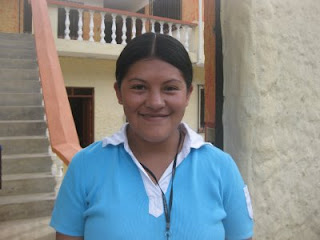
Following the fiesta, agronomy student Verónica Huanca defended her research project about lichens on coffee bushes. She identified 122 species of lichens, with a project inspired by Dr. Arvid Boe, a collaborator from South Dakota State University.


Photo: New graduate Verónica Huanca signs her graduation document.


Thursday, Mariana Llanos defended her vet science project, discovering that 86% of dogs in Coroico have at least one parasite, and that some parasites, like giardia, are more common in the wet season. Her research helps the residents of Coroico know what parasites their canine companions suffer from so that they can treat them. This is important both for the health of their pet, and for the owners' own health: some of these parasites infect humans, too.


Photo:Mariana Llanos poses with a canine friend before her defense.


Today our three latest nursing graduates who were celebrated at the College's inaugural mass came back to campus today to sign their graduating documents.


Photo: Sister Jean talks about how these young nursing graduates help fulfill the mission of the College, making Sister Damon's vision a reality.


After the ceremony with the nurses, vet student Reyna Carrizales defended her research project about disinfection techniques at the municipal slaughterhouse in nearby Coroico. She discovered that disinfection with bleach or ammonia eliminated pathogenic bacteria like E. coli. The slaughterhouse, which was not disinfecting at all, now uses bleach, and, according to Reyna, consumer confidence and meat consumption in Coroico is up.


Photo: New graduate Reyna Carrizales.

Monday, August 31, 2009

The haps at the house

We have had some happenings at the house -- new visitors and visiting professionals, too. Catherine Moriarty is our permanent visiting professional this semester, a graduate from Smith College, and our superstar English teacher in the Education and Agronomy programs as well as the tourism English backstop. More about Catherine later.

The past month we also had a high school student here, Isaac, helping out on campus, as well as Marta, an education expert from Barcelona giving workshops this month to different groups on campus. Sarah's friend Kelly was visiting from Minneapolis, too. It was a full house in Carmen Pampa.


Photo: Sarah, Hugh, Marta, Isaac, Sister Jean and Kelly pose for a photo after Isaac's going away dinner of lasagna, prepared by Kelly with homemade ricotta.

Mario Choque

Friday was the defense of Mario Choque, a student who started at the College more than ten years ago. He researched the best time to castrate piglets, and discovered that it didn't matter if it were earlier or later, only that it matters (meat from uncastrated males is not tasty).

He joins his wife Elizabet Lluta, a nursing department graduate from the College, to form one more husband-wife team of professionals.


Photo: New graduate Mario Choque signs a copy of his research project as representative from Catholic University Ramiro Fernández looks on.

Tuesday, August 25, 2009

Liliana and Ferns

A student of mine, Liliana Condori, went to a workshop about ferns at the Herbario del Sur in Monteagudo, close to the Constitutional Capital of Bolivia, Sucre. It covered the usual: identification, ecology, biology. And she came back excited to research the ferns that grow on our mountain, Uchumachi. When I used to teach ecology at the College, I got really excited about ferns, too: they are so varied, and beautiful. Our forest is home to a few species of tree ferns, delicate ground ferns, bizarre climbing ferns, and more. I am excited about her project, and I am sure that she will make some interesting discoveries.


Photo: Liliana (in pink) sits with the workshop participants to examine their newly collected specimens.

Sunday, August 23, 2009

Beautiful mass

We had a beautiful mass today in Carmen Pampa by Father Israel. The 4:30 p.m. Sunday mass is attended by students both from the high school and the College, as well as people from the community. What a gift the church is!

Today's mass was especially poignant because it was celebrated in remembrance of George Murnane, husband of past Carmen Pampa Fund executive director Fran Rusciano Murnane, who passed away this past Tuesday. Fran, you and your family are in our prayers here in Carmen Pampa.


Photo: Father Israel celebrates mass in Carmen Pampa.

Saturday, August 22, 2009

Lettuce and carrots and beans, oh my!

There are many interesting techniques to produce organic vegetables: companion planting, double-digging, mulching, manuring. Student Rubén Quispe did a project comparing these techniques, and discovered that growing carrots, lettuce, beans, summer savory and basil together with double-dug beds, mulch and chicken manure resulted in big increases in production compared to the region's traditional horticulture techniques.


Photo: Rubén signs a copy of his thesis after his successful defense.

Rubén is a very quiet and humble young man, and very generous with his time. While he was (supposedly) writing up his project, I often found him helping other students with their projects, especially statistics. I joked with him that it took him so long to graduate because he spent so much time helping other students with their projects. But graduate he did, and we send one more professional off into the world to help all live dignified lives.


Photo: Rubén stands with his defense committee (L to R: Ángel Garabito, Desiderio Flores, Rubén Darío Gómez, Rubén Quispe and Hugh Smeltekop).

Friday, August 14, 2009

Pesticides

The other side of our mountain Uchumachi is the community of Trindad Pampa. Trinidad Pampa produces a lot of coca, and conventional coca production involves a lot of insecticides. Nursing student David Uria did his graduation project about the use of pesticides in this community, and found that over 80% of producers do not use these products according to the label, and none of them use significant protection when applying them.

Today David defended his project, and became our latest graduate! David currently works as the health specialist in the municipal office in nearby Coroico, and said that these data, and other research at the College, are very useful to the region as they make plans to help farmers take better care of themselves and their families. David is special for another reason: he is from the community next to Carmen Pampa, a "local boy" working to improve the health of his community and other communities like his in the municipality. Go, David!


Photo: David receives his diploma from Director Father Freddy.

Thursday, August 13, 2009

A new species of passion fruit

Student Porfirio Kapa became the College's latest graduate yesterday, with a research project about starting two species of passion fruit from cuttings. (Passion fruit is named for the Passion of Christ: The vine resembles the whip used to flagellate Christ, the corona threads resemble a crown of thorns, the three stamens represent the three nails used to nail Christ to the cross, and the five anthers are the five wounds on Christ's body.)


Photo: Porfirio poses in front of his passion fruit nursery.

Both species grew from cuttings from the stem, with over 90% success with the known species, and around 60% for the unnamed species.


Photo: The unnamed species of passion fruit. Porfirio says that the only people who eat this fruit now are kids and monkeys!

Congratulations to Porfirio. We expect his wife Maribel Villca to graduate with in the next few months, as our family of graduates grows.

Friday, August 07, 2009

Sad news

We got the terrible news last night: the father of Janneth Mamani, the student in La Asunta that Sarah wrote about last week, died the night before last. Janneth's brother Nelson, is also a student at the College, in the ecotourism department.photo of Janneth Mamani from Sarah Mechtenberg

Janneth's boss sent her in a truck that night from La Asunta to La Paz, a long trip, where her family was sitting with the body, distraught. The death was totally unexpected -- there were no signs that there was anything wrong.

I went to the house today. Uncles and aunts sat and talked and cried with the family, Janneth sitting at her mother's side along with her two brothers. The body will be at the family house until tomorrow when it will be taken to the cemetery around the corner, in the Río Seco section of the Alto, the sad, barren, cold and windy place where the city of La Paz ends and the Altiplano begins. Please keep the family in mind these days. We will, too.

Thursday, August 06, 2009

Independence day in Coroico

Today the whole college goes to Coroico to participate in the Independence Day activities. It starts with a mass...


...and ends with patriotic speeches and everyone marching in front of the church for all the town to see. Here are our best three students at the College from Vet Science, Samuel Málaga, from Education, Rocío Adrián, and from Agronomy, José Luis Chipana.

Wednesday, August 05, 2009

Inaugural Mass

August 4th was the inaugural mass of the second semester this year. It is always amazing to see the whole school in one place.


Sister Jean always does something cool with the liturgy (check out the flower-adorned altar servers with smiles to beat the band).


Lidia Cuevas addressed the student body with an inspiring recollection of the nursing profession.


The mass also honored three graduates of the nursing department. Here is Sister Jean with these new graduates, Agustín, Concepción and Alexander.

Monday, August 03, 2009

Día del Campesino

August 2nd is the Día del Campesino, also known as Día del Indio, a day to celebrate being indigenous and preserving the culture and values of these rural areas.

The day started with a mass, then speeches, and then a parade with students from kindergarten through college.

Here are the students from the elementary school in San Pedro de la Loma, a small community near the College -- ready to march!


And here is the president of the town council, the subprefect, and our Director Father Freddy.


Here new graduate Policarpio Apaza*, also from San Pedro de la Loma, leads his fellow community members in the parade, with the Aymara Nation flag, the Wiphala.


Last in the parade are our students from the College. Here some agronomy students line up, ready to march through the high school grounds in honor of their roots as children of the land.


_______________
*I didn't write about Policarpio's research project defense, July 13th, in La Paz. A "native son" of the valley where the College sits, he looked at chicken stocking densities, and found that less chickens per area meant better conversion of feed to meat, but that more chickens per area was more profitable (12 chickens per square meter). He plans to start a small community-run chicken farm in his community.

Thursday, July 09, 2009

Magdalena Makes it Big!


My first day in Carmen Pampa was marked by a wonderful event. Magdalena Colque defended her thesis succesfully and received her degree in Veterinary Science from the UAC. Her family and friends travelled from afar to support her and were very proud of her achievements. We celebrated with a lovely almuerzo meal during which her mother, Basilia shared her pride in her daughter and Magda shared her excitement in her future spreading her knowledge with people in her pueblo and her future as a professional.

Paula Smeltekop on friendly hosts


These beautiful Bolivian women represent three generations living together in a small town. They seemed very happy with one another and confident in the world. I thought they were a good example of how living in an extended family supports each member. I was amazed when the youngest (7) took my hand and accompanied me all over town looking for bottled water. Since my Spanish is limited, she made sure that I was understood, especially when my answer was no. I cannot imagine an American seven year old behaving with such self assurance.

Guest Blogger: Paula Smeltekop on visiting Carura

My sister Paula is here visiting, and she agreed to write for the Carmen Pampa blog. Thanks, Paula!

_____________________


The beauty and uniqueness of Bolivia is astounding. Our first stop after landing in the FRIGID El Alto Airport in La Paz was to visit College's nursing student José Luis Gómez in his hometown of Carura. Three taxi rides later, Jose Luis' extended family welcomed us warmly with food, companionship and a beautiful place to stay. We are standing above the River in 80 degree weather contemplating a swim. Unbelieveable that we had to change our clothes from winter to summer in just a few hours!

Wednesday, June 24, 2009

Butterfly man

We have a new graduate, a butterfly man, Hebert Velásquez. Hebert researched the life cycle of two butterflies, Danaus plexippus (the Monarch) and Leptophobia aripa (a delicate, white thing called the White Mountain butterfly, which is also a cabbage family pest).


Photo: A Monarch butterfly ready to leave its cocoon.

Photo: The White Mountain butterfly.


The work was done in conjunction with the Cotapata National Park, the Instituto de Ecología at the state university in La Paz called the Universidad Mayor de San Andrés, and the Fundación Puma. The idea was to develop an inexpensive and low-tech way to raise these two species of butterflies. The Monarch is a commercial species, sold live to butterfly houses and sold mounted as a decoration. The White Mountain is released en masse at weddings and other fiestas, a delicate cloud of white butterflies to celebrate the occasion. A community butterfly project in the national park, called Mariposario Nayriri, will use the data to commercialize these two species sustainably.

Here is Hebert is the lab, changing the caterpillars' food.


Great job, Hebert.

Thursday, June 04, 2009

Victor Hugo and Maria Esther

Volunteers Jessica and Kirsten interviewed some students who received support for their graduation projects from conBolivia. ConBolivia is an NGO that supports different efforts in Bolivia, and faithfully supports students at the College. Here is what Jess and Kirsten wrote:

____________________

Victor Hugo Belmonte is from El Alto and came to Carmen Pampa to study Agronomy because he likes plants and people. His senior project is about the drying time of coffee beans. He chose this project because he wanted to create a more efficient way to dry coffee, a problem in our Cloud Forest area. He is very pleased with his results so far: he has found that using the tarp cuts down drying time and therefore cuts down costs. He is currently in the writing stage of his project. He wants to thank conBolivia for the help at a time when he really needed it.

[Andy wrote about Victor Hugo last August – see his interview here.]

Maria Esther is originally from Caranavi, a town four hours from Carmen Pampa, but now lives in Carmen Pampa with her family. She chose to study Agronomy at Carmen Pampa because she thinks it is practical and useful. She is studying the in vitro cultivation of orchids with coconut juice (that liquid in the coconut), potato flour, banana flour, and tomato juice to see which would be best in the lab. She chose this project because this type of flower is disappearing in the countryside and she wants to increase the production of all types of orchids. In order to do this, she says that it is important to find a way to keep the prices low. She is currently writing up her research. After she graduates, she wants to continue to study, focusing on lab work. She wants to work in the lab with endangered plants and teach people about the environment and how to prevent extinction of plants. She wants to thank conBolivia for the financial support that helped her to quickly finish her fieldwork.

[Katrina talked to María Esther last August – see her interview here.]

Friday, May 29, 2009

Three May graduates

So there were three graduates this month, and I had something to do with each one.

First was Miguel Manrique, who looked at two important families of insects, Reduvidae and Pentatomidae. Reduvids are called assassin bugs because they are insane predators, like the Terminator, totally destroying other insects, often pests in our fields. Pentatomids include stink bugs, and can be garden pests. He discovered that there is less diversity in these families than other families, and that there is a gradient of species as one moves from the forest to the forest edge to the field. I was Miguel's research project adviser, and he is now the head of our insect diversity project, which supervises the collection of insects all around the College.


Then came Jorge Apala. Jorge and I started the goat project in Coroico Viejo in 2002. We traveled all over Bolivia in search of goats to populate the project, at one point driving from Santa Cruz to Cochabamba to La Paz with a Land Cruiser full of goats -- 18 goats at once! (It was a smelly ride.) Of the goats we bought and brought to our experiment station in Coroico Viejo, Jorge discovered that the variation between milk production depended more on the individual goat than its purported race. I personally had a special love for the Anglonubians. They were the friendliest...


Last was Edwin Zapata. He researched wasps that live in our forest and fields. His research demonstrated that many wasps are able to survive in different habitats, most of them looking for other insects to scoop up and eat. I was the project adviser for Edwin, too.


It is always hugely gratifying to see these young people take their oath as a new agronomist or veterinarian, and hear their words of thanks to their professors and other mentors. None of them forget to thank Sister Damon for how she touched each of them personally. And now it is their turn to move others.

Thursday, May 28, 2009

Lots going on

Things have been so busy this month that I haven't had time to post. So here it goes: a months worth of news.

Early in the month I became a Godfather (again), the son of a friend who lives across the valley in San Juan de la Miel. Here is a guest pinning money to the child's shirt, a tradition to raise money for the child's future.


I was in Michigan and Minnesota for a few days in early May. I spent some time with family. Here is my sister Paula with her horse River.


May 7th was the Fiesta del Ayni, a fund raiser for the College, and a way to get in touch with the huge base of generous people that support us. Here I am with Sister Damon.


And here is Ann Leahy, part of the team that helped Sister Damon start the College back in 1993. Here she stands before a model of the campus, with two cars ready to race up the hill, powered by supporter's donations. One car was Sister Damon, looking for funds for the bootcamp that supports students doing their graduation research projects; the other was Dick Leahy, looking for funds for the student-run food program. The first one to the top of the hill asked our director Father Freddy to call Carmen Pampa Fund director Sue Wheeler to ask for matching funds. (The terrible part about it is that we really just do have one phone, on the upper campus. Ironically, we do have Internet on both campuses.)


My sister Paula came to the event, and to spend a few days with me in Minnesota -- we had a great time walking around the city and spending time with former volunteer Becky. Here is Paula with Becky at the Guthrie Theater.


And we also met up with another former volunteer, Matt.


I also got to see other former volunteers Beth and Ana (with me at a Denny's), and Christine, out for Chinese food in St. Paul.


On May 11th I flew to Chicago and met up with 7 visiting scholars from South Dakota State University. We spent 10 days teaching workshops and working on collaboration plans. Here is the crew on the first day.


Here Agronomy Director José Luis Beltrán gives a talk about quantitative measurements in ecological systems.


We had lunch with different groups of students and faculty every day.


Dr. Brent Turnipseed talked about seed evaluation techniques.


Dr. Paul Johnson talked about insect collecting and diversity.


Dr. K.C. Jensen talked about bird identification and ecology.


On one of our last days, we took an excursion into the Cotapata National Park. Our minibus driver for the week, Nicolás, took us on a hike up the Río Elena to the secret Cock-of-the-Rock feeding grounds.


...and we saw two females and a male, with a bright red crest -- amazing.


Then went to the Nayriri Butterfly House in a small community nearby, Chairo. Here is the technician Guillermina Cos and a consultant, Martín Apaza, along with Paul Johnson.


After the South Dakota folks left, we had a few research project defenses -- but it is getting late, so I will write about that sometime soon. Needless to say, it was a real full month -- and it isn't even over!