Two new graduates in the vet department: Ariel Torrelio and Silvia Yujra.
Silvia looked at the digestion of plants in goats -- by putting mesh bags of forages in a hole in their stomachs! The process, called fistulation, required a simple surgery, and does not harm the animal. The results showed that the goats digested supplemental legume forages more readily, and that grass forages provided the roughage that they needed.
Ariel looked at parasites in sheep, and found a variety of parasites that were easily treated with anti-parasite medicine; but that animals on common grazing pasture are readily re-infected, requiring that all herders deparasitize their animals at the same time.
Both students have been at the college for many years, and we are glad to see these "veterans" reach their dream.
Saturday, June 28, 2008


Wednesday, June 25, 2008
New corn variety
Corn is not widely grown in the Yungas -- root crops like taro, manioc and racacha are the more typical starch crops. To help farmers increase their options for basic food crops, student Aldo Estévez worked with farmers in a community across the valley, San Juan de la Miel, to introduce two new corn varieties. One of these varieties, a hybrid called Tuxpeño opaco 2, adapted well to the climate, outperforming the most common local variety Cubano. These farmers now have a new variety of corn to add to their toolbox, and the college now has one more new graduate. Congratulations, Aldo.
__________________
P.S. Years ago when I worked with families around Carmen Pampa to grow kitchen gardens. An old widow and her teenage son from San Cristóbal who participated invited me to dinner one night, and we had sopa de choclo, corn soup, with a corn variety like the one Aldo researched. Here is the recipe.
5 cobs corn (ripe sweet corn or field corn at milk stage)
1 onion, peeled and diced
2 T. oil (or butter)
3 cloves garlic, minced
salt and pepper to taste
1 cup grated cheese (salty fresh campo cheese is nice)
* Cut corn from the cob and grind with an old hand grinder; or blend kernels with some water in the blender.
* Saute onion in butter or oil until soft; add garlic and saute 2 minutes more.
* Add ground corn, 4-6 cups water (for a thicker or thinner soup), salt and pepper. Boil for a few minutes.
* Serve hot with cheese on top.
__________________
P.S. Years ago when I worked with families around Carmen Pampa to grow kitchen gardens. An old widow and her teenage son from San Cristóbal who participated invited me to dinner one night, and we had sopa de choclo, corn soup, with a corn variety like the one Aldo researched. Here is the recipe.
5 cobs corn (ripe sweet corn or field corn at milk stage)
1 onion, peeled and diced
2 T. oil (or butter)
3 cloves garlic, minced
salt and pepper to taste
1 cup grated cheese (salty fresh campo cheese is nice)
* Cut corn from the cob and grind with an old hand grinder; or blend kernels with some water in the blender.
* Saute onion in butter or oil until soft; add garlic and saute 2 minutes more.
* Add ground corn, 4-6 cups water (for a thicker or thinner soup), salt and pepper. Boil for a few minutes.
* Serve hot with cheese on top.
Tuesday, June 24, 2008
Let's hear it for Rotary Club!
Last week we had two friends from Iowa on campus, Bob Rennebohm and Russ Hill from the Rotary Club of America in Des Moines, Iowa. Their club, in association with the club La Paz-Sur in Bolivia, are sponsoring the construction of a recycling center. The center will collect and process garbage from Campus Manning, the community and the high school, and serve as a training center for students of all ages.
The week started with a ground-breaking ceremony with the biship of Coroico Monseignor Juan Vargas, the community president Willie Aliaga, and students from the college.

Photo: Bob and Russ at the construction site.
Later the members of the La Paz club came and we spent the afternoon sharing stories and visiting the highlights of campus.
The rest of the week they toured the campus, eyes open for other possible projects in the future, and soaked in the atmosphere of student life.
We were very grateful for their visit -- seeing the college with your own eyes is an experience unto itself, and we see ourselves in new ways when visitors come and share their experience. And grateful for their generosity: the recycling center is college dream, ignited by Franciscan missionary Alexandra Hoch during her service in 2002-2004.
The week started with a ground-breaking ceremony with the biship of Coroico Monseignor Juan Vargas, the community president Willie Aliaga, and students from the college.

Photo: Bob and Russ at the construction site.
Later the members of the La Paz club came and we spent the afternoon sharing stories and visiting the highlights of campus.
The rest of the week they toured the campus, eyes open for other possible projects in the future, and soaked in the atmosphere of student life.
We were very grateful for their visit -- seeing the college with your own eyes is an experience unto itself, and we see ourselves in new ways when visitors come and share their experience. And grateful for their generosity: the recycling center is college dream, ignited by Franciscan missionary Alexandra Hoch during her service in 2002-2004.
Saturday, June 21, 2008
Cattle and Coffee
Yesterday morning, two more students successfully defended their research projects.
First was Juan Enrrique Chambi, who worked with a cattle ranch in the tropics of Bolivia to see whether the cattle did better walking to the market (a 3 day walk), or traveling in a truck to market. It turned out that walking the cattle to market was more effective in terms of stress on the cattle, and economically. This information helps the ranch where the study was done, and applies to ranches all over that region.
Then Richard Agramont defended his project comparing different traps to reduce the population of the coffee borer pest in the region's coffee fields. The biggest pest problem in Bolivia in this coffee bean pest, leading to losses of up to 50% of the coffee crop. Richard calculated the losses in this area at 20%.
Richard concluded that using locally-made traps with a mixture of ethanol and methanol was the most effective trap, as well as the least expensive. Richard has already spoken with farmer groups in Coroico and Caranavi, and is helping these farmers build and install traps, made very simply with plastic 2 liter bottles.

Photo: Richard Agramont examining coffee borer damage.
Congratulations to these two new graduates!
First was Juan Enrrique Chambi, who worked with a cattle ranch in the tropics of Bolivia to see whether the cattle did better walking to the market (a 3 day walk), or traveling in a truck to market. It turned out that walking the cattle to market was more effective in terms of stress on the cattle, and economically. This information helps the ranch where the study was done, and applies to ranches all over that region.
Then Richard Agramont defended his project comparing different traps to reduce the population of the coffee borer pest in the region's coffee fields. The biggest pest problem in Bolivia in this coffee bean pest, leading to losses of up to 50% of the coffee crop. Richard calculated the losses in this area at 20%.
Richard concluded that using locally-made traps with a mixture of ethanol and methanol was the most effective trap, as well as the least expensive. Richard has already spoken with farmer groups in Coroico and Caranavi, and is helping these farmers build and install traps, made very simply with plastic 2 liter bottles.

Photo: Richard Agramont examining coffee borer damage.
Congratulations to these two new graduates!
Tuesday, June 17, 2008
The Bee's Knees
Oscar Claros, a student in the agronomy department, defended his research project today, examining the diversity of insects in the superfamily Apoidea, a.k.a. bees. He collected 83 different species, tracing them to different ecological niches. He dedicated the work to his father, who passed away before seeing his son graduate from the college. Congraduations on your hard work, Oscar. Your father would be proud.

Photo: Oscar with a Malaise insect trap, used for flying insects.

Photo: Oscar with a Malaise insect trap, used for flying insects.
Friday, June 13, 2008
Water System a Go
In 2005, through a generous donation from the Sieben Foundation, matched by USAID, the UAC built and runs a coffee processing plant, transforming coffee berries into green coffee beans, ready for toasting for the local market or for export.

Photo: Coffee processing plant in Carmen Pampa.
This transformation results in a large quantity of wastewater, and the plant has a wastewater treatment system that removes solids with filters and flocculation, and then oxygenates the water to remove the last of the pollutants. Then the water is discharged back into the environment.

Photo: Water treatment system.
Student Javier Álvarez supervised the wastewater treatment process last year as his research project, and found that the system did not effectively remove soluable solids from the wastewater. Javier had suggestions about how to improve the process, especially some modification of the oxigenation tanks to take better advantage of bacteria from the environment to degrade these solids; and cleaning the beans mechanically instead of depending on a fermentation process to remove the mucilagenous layer of the beans.
Javier got a 90 on his defense, the highest score this year so far. Nice job, Javier!

Photo: Javier testing the coffee plant wastewater.

Photo: Coffee processing plant in Carmen Pampa.
This transformation results in a large quantity of wastewater, and the plant has a wastewater treatment system that removes solids with filters and flocculation, and then oxygenates the water to remove the last of the pollutants. Then the water is discharged back into the environment.

Photo: Water treatment system.
Student Javier Álvarez supervised the wastewater treatment process last year as his research project, and found that the system did not effectively remove soluable solids from the wastewater. Javier had suggestions about how to improve the process, especially some modification of the oxigenation tanks to take better advantage of bacteria from the environment to degrade these solids; and cleaning the beans mechanically instead of depending on a fermentation process to remove the mucilagenous layer of the beans.
Javier got a 90 on his defense, the highest score this year so far. Nice job, Javier!

Photo: Javier testing the coffee plant wastewater.
Saturday, June 07, 2008
Primary Education Anniversary
June 6th is the Día del Maestro in Bolivia, National Teacher's Day, and also the anniversary of the Primary Education Department, now seven years old.
The celebrations started with seminars on Thursday night about education reform in Bolivia, and the Aparecida Document from General Conference of Bishops of Latin America and the Caribbean. Friday was dedicated to a mass, then sports during the day and a cultural night in the evening.
The cultural night started with the presentation of an award to Ricardo Trigoso, the founder of the department. He gave credit to Sister Damon for her vision, and emphasized the importance of education, especially on the elementary level. That was followed by poetry, music and dancing, especially the traditional dances from Bolivia. Ecotourism did an incredible interpretation of a dance from the Amazon; and each education class presented a different dance: Calcheño (inset), Morenada, Waca Waca and Diablada.

Today is more sports and a dance at 8 p.m. Congrats to Education on their anniversary, and to Sister Damon, Ricardo Trigoso, Eustaquio Menacho and Andrés Pardo, the leaders of this incredible department.
The celebrations started with seminars on Thursday night about education reform in Bolivia, and the Aparecida Document from General Conference of Bishops of Latin America and the Caribbean. Friday was dedicated to a mass, then sports during the day and a cultural night in the evening.
The cultural night started with the presentation of an award to Ricardo Trigoso, the founder of the department. He gave credit to Sister Damon for her vision, and emphasized the importance of education, especially on the elementary level. That was followed by poetry, music and dancing, especially the traditional dances from Bolivia. Ecotourism did an incredible interpretation of a dance from the Amazon; and each education class presented a different dance: Calcheño (inset), Morenada, Waca Waca and Diablada.

Today is more sports and a dance at 8 p.m. Congrats to Education on their anniversary, and to Sister Damon, Ricardo Trigoso, Eustaquio Menacho and Andrés Pardo, the leaders of this incredible department.
Thursday, June 05, 2008
Beans!
Minutes ago, another student from the agronomy department successfully defended his research project -- one more graduate!
Zenón Maquera compared the production of 7 varieties of beans in the community of Coroico Viejo, across the valley where the university has an experiment station. Beans can have a great impact on the poor nutrition in the region where protein and iron deficiencies are major reasons for poor development and illness in children.
Zenón went beyond the scope of his project, meeting with farmers and helping them plant the best varieties and even teaching the families to cook them. Thank you, Zenón -- you will go far.

Photo: Zenón in Coroico Viejo clearing the field for his beans.
Zenón Maquera compared the production of 7 varieties of beans in the community of Coroico Viejo, across the valley where the university has an experiment station. Beans can have a great impact on the poor nutrition in the region where protein and iron deficiencies are major reasons for poor development and illness in children.
Zenón went beyond the scope of his project, meeting with farmers and helping them plant the best varieties and even teaching the families to cook them. Thank you, Zenón -- you will go far.

Photo: Zenón in Coroico Viejo clearing the field for his beans.
Wednesday, June 04, 2008
One for the fungus
An agronomy student, Ruddy Nina, successfully defended his research project yesterday. Coffee seedlings sometimes suffer from damping off, a fungal disease that attacks the roots and stems. One organic way to treat this disease is by applying another fungus that prevents the disease. Ruddy looked at how the biological control fungus Trichoderma affects fungi that cause damping off, and noted that in the laboratory, Trichoderma can reduce the growth of the pathogen by 60%. Call that one for the fungus, and one for the UAC, as the agronomy department gradutes its 47th student. Way to go, Ruddy.
Saturday, May 31, 2008
(No) rotten tomatoes
One more! Marcos Aguilera defended his research project comparing our local tomato variety to five new tomato varieties in the Cloud Forest region of Bolivia. He discovered that our typical variety outperformed the new varieties, hands (vines?) down. One more graduate! We are proud of him.
Wednesday, May 21, 2008
Our incredible forest
Two agronomy students defended their research projects yesterday. Stevia is a plant from which people extract a natural, no-calorie sweetener. It is popular in Asia, and some U.S. and european companies are looking into using it in place of sweeteners like aspartame (Equal). Student Emilio Condarco looked at soaking stevia cuttings in coconut juice to increase transplanting success (it worked: only 60% of the plants without the coconut treatment survived, but 75% with the coconut juice soaking). Congratulations, Emilio!
Then Pedro Cruz defended his project examining trees on the mountain that overlooks the university, Uchumachi. He identified 1587 trees with a diameter of 10 centimeters or less in about an acre, finding 38 families of trees. He compared unmanaged forest (primary forest) with forest that has been managed by people (secondary forest), and found that the unmanaged forest has higher diversity and bigger trees. He also found that some key species like bolivian cedar (Cedrela fissilis) and incence trees (Clusia flaviflora) are not regenerating in the secondary forest. These conclusions will help communities here and in the whole Cloud Forest region manange their forest so that it remain a resource for food, fuel, forrage, medicine and construction.
Pedro spent a year climbing Uchumachi to examine the trees, and sampling them when they were in bloom to get samples to identify in the National Herbarium of Bolivia. His dedication to his long but fruitful project is astounding to me, and I have to say that I am especially proud of this young man. Felicidades, Pedro.
Then Pedro Cruz defended his project examining trees on the mountain that overlooks the university, Uchumachi. He identified 1587 trees with a diameter of 10 centimeters or less in about an acre, finding 38 families of trees. He compared unmanaged forest (primary forest) with forest that has been managed by people (secondary forest), and found that the unmanaged forest has higher diversity and bigger trees. He also found that some key species like bolivian cedar (Cedrela fissilis) and incence trees (Clusia flaviflora) are not regenerating in the secondary forest. These conclusions will help communities here and in the whole Cloud Forest region manange their forest so that it remain a resource for food, fuel, forrage, medicine and construction.
Pedro spent a year climbing Uchumachi to examine the trees, and sampling them when they were in bloom to get samples to identify in the National Herbarium of Bolivia. His dedication to his long but fruitful project is astounding to me, and I have to say that I am especially proud of this young man. Felicidades, Pedro.
Sunday, April 27, 2008
Avalanche!
I know what you are thinking -- a landslide on the unstable Andean cloud forest roads. But no: The UAC saw 5 students graduate in the past week -- and the prognostication shows chances of another graduate on Monday are great!
Lalo Chipana defended a research project about the incidence of rabies in La Paz early in the week. On Tuesday Nelva Guzman defended her project about coffee fermentation techniques, and Jorge Gallardo about another aspect of coffee production. Friday Isidro Mamani, a student who grew up in the community of Carmen Pampa, defended his project about the adaptation of soybeans to the region; and on the same day another student, Veymar Silva, successully defended his work about the varieties of banana and plantain in the area.
The defenses corresponded with the visit of Ann Leahy, Sue Wheeler and Joel Mugge from the Carmen Pampa Fund, and they where there when Nelva Guzman became yet another Carmen Pampa success story (photos to come). It was a beautiful moment, with smiles and tears shared by Nelva and her family, her project guidence committee, the head of her department, the director of the university, and our friends from the Carmen Pampa Fund who make this success possible.
And we can't say it enough: Thank you. To everyone who supports the college in all of the different ways. Thank you. Thank you so much.
Lalo Chipana defended a research project about the incidence of rabies in La Paz early in the week. On Tuesday Nelva Guzman defended her project about coffee fermentation techniques, and Jorge Gallardo about another aspect of coffee production. Friday Isidro Mamani, a student who grew up in the community of Carmen Pampa, defended his project about the adaptation of soybeans to the region; and on the same day another student, Veymar Silva, successully defended his work about the varieties of banana and plantain in the area.
The defenses corresponded with the visit of Ann Leahy, Sue Wheeler and Joel Mugge from the Carmen Pampa Fund, and they where there when Nelva Guzman became yet another Carmen Pampa success story (photos to come). It was a beautiful moment, with smiles and tears shared by Nelva and her family, her project guidence committee, the head of her department, the director of the university, and our friends from the Carmen Pampa Fund who make this success possible.
And we can't say it enough: Thank you. To everyone who supports the college in all of the different ways. Thank you. Thank you so much.
Monday, March 31, 2008
Student Science Competition
This past week, students from the Education, Veterinary/Animal Science, Nursing and Agronomy departments presented research projects that they did last semester. Of the 12 projects presented, UAC graduates from each major chose the best four. These four groups of students competed Saturday night at the Science Competition Finals.
The agronomy group presented an experiment looking at the best way to graft citrus trees (on young branches with strips of plastic).

Photo: Wilma Pari, Harold Rivera, Marco Pardo and Ever Misange talk about orange tree grafting.
The education students worked with children 6 to 24 months and scored them on different developmental scales before and after sessions of constructive play to look at the effect of stimulation on their development.

Photo: Two education students discuss their project.
A young women in the vet and animal science department examined the effect of vitamins and a progesterone blocker on the development of guinea pigs. Vitamins stimulated growth more than the hormone and the control animals.
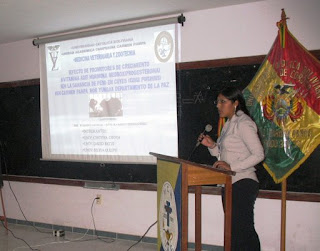
Photo: Cintia Otoya talks about her guinea pig experiment.
The nursing students presented the results of a survey about the prevelance and causes of athlete's foot in students at the UAC. Students in the agronomy department shower only 2 times per week on average, but had less foot fungus than other students; the future nurses recommended more frequent scrubbing of the communal shower stalls.

Photo: Students Bertha, Leonela and Paola pose with their research advisor Dr. Cinzia Quezada (in white).
And the nurses won it! We are proud of all of the students who participated, and especially proud of the finalists.
The night ended with an award for Manuel Loza, a biochemistry professor who was instrumental in the creation of these competitions. He received a pewter clock inscribed with his name and a dedication.

Photo: Manuel Loza admires his new clock as the night's M.C. Hugh Smeltekop looks on.
We were also grateful for the distinguished panel of judges of the evening: Our director Father Freddy del Villar, the coordinator of satellite campuses of the Catholic University of Bolivia Gustavo Escalier, a social worker from the Alto Sonia Castro, and a doctor from the Hospital of the Yungas in Coroico Dr. José Luis Oblitas.

Photo: José Luis Oblitas, Sonia Castro, Gustavo Escalier and Padre Freddy del Villar sit at the judges table.
The funds for these research projects came from a donation by Dr. Carol Wake at South Dakota State University. A very warm thank you to Carol from everyone here in Carmen Pampa. Abrazos!
The agronomy group presented an experiment looking at the best way to graft citrus trees (on young branches with strips of plastic).

Photo: Wilma Pari, Harold Rivera, Marco Pardo and Ever Misange talk about orange tree grafting.
The education students worked with children 6 to 24 months and scored them on different developmental scales before and after sessions of constructive play to look at the effect of stimulation on their development.

Photo: Two education students discuss their project.
A young women in the vet and animal science department examined the effect of vitamins and a progesterone blocker on the development of guinea pigs. Vitamins stimulated growth more than the hormone and the control animals.

Photo: Cintia Otoya talks about her guinea pig experiment.
The nursing students presented the results of a survey about the prevelance and causes of athlete's foot in students at the UAC. Students in the agronomy department shower only 2 times per week on average, but had less foot fungus than other students; the future nurses recommended more frequent scrubbing of the communal shower stalls.

Photo: Students Bertha, Leonela and Paola pose with their research advisor Dr. Cinzia Quezada (in white).
And the nurses won it! We are proud of all of the students who participated, and especially proud of the finalists.
The night ended with an award for Manuel Loza, a biochemistry professor who was instrumental in the creation of these competitions. He received a pewter clock inscribed with his name and a dedication.

Photo: Manuel Loza admires his new clock as the night's M.C. Hugh Smeltekop looks on.
We were also grateful for the distinguished panel of judges of the evening: Our director Father Freddy del Villar, the coordinator of satellite campuses of the Catholic University of Bolivia Gustavo Escalier, a social worker from the Alto Sonia Castro, and a doctor from the Hospital of the Yungas in Coroico Dr. José Luis Oblitas.

Photo: José Luis Oblitas, Sonia Castro, Gustavo Escalier and Padre Freddy del Villar sit at the judges table.
The funds for these research projects came from a donation by Dr. Carol Wake at South Dakota State University. A very warm thank you to Carol from everyone here in Carmen Pampa. Abrazos!
Saturday, March 22, 2008
Way of the Cross
Today was the Vía Cruces, the Way of the Cross. It was powerful, walking Jesus' walk. Hope your Easter is as inspiring as ours.

Photo: UAC graduate Lupe Figueredo carries the cross.

Photo: UAC graduate Lupe Figueredo carries the cross.
Saturday, March 01, 2008
Two more
Thursday two more students defended their research projects.
First was Sergio Campero. He looked at the production of lettuce in cheap, easy-to-assemble greenhouses made with plastic and PVC tubes, comparing traditional soil preparation and double-digging. He found that double-digging the soil plus using the little "hoop houses" was much, much more effective than the traditional planting technique.

Photo: Sergio explains his experiment in front of the university director and a panel of his professors.
Then came Leyla Yujra. She researched germination techniques for a new crop in the area, stevia (Stevia rebaudiana), a natural sweetener. She found that plants produced under a tarp raised on poles with compost for fertilizer was much more effective than other techniques, such as production in a greenhouse, or with chicken manure for fertilizer.

Photo: Director Father Freddy, Agronomy department director José Luis Beltrán, new graduate Leyla Yujra, Dr. Johann Krug from the German Development Agency GTZ, and Jesús Sanez, head of FONADAL projects for the Nor Yungas province.
Congratulations to these two new graduates!
And thank you to South Dakota State University/Larsen Foundation, and to FONADAL, for helping with the Thesis Bootcamp that made the graduation of these students possible.
First was Sergio Campero. He looked at the production of lettuce in cheap, easy-to-assemble greenhouses made with plastic and PVC tubes, comparing traditional soil preparation and double-digging. He found that double-digging the soil plus using the little "hoop houses" was much, much more effective than the traditional planting technique.

Photo: Sergio explains his experiment in front of the university director and a panel of his professors.
Then came Leyla Yujra. She researched germination techniques for a new crop in the area, stevia (Stevia rebaudiana), a natural sweetener. She found that plants produced under a tarp raised on poles with compost for fertilizer was much more effective than other techniques, such as production in a greenhouse, or with chicken manure for fertilizer.

Photo: Director Father Freddy, Agronomy department director José Luis Beltrán, new graduate Leyla Yujra, Dr. Johann Krug from the German Development Agency GTZ, and Jesús Sanez, head of FONADAL projects for the Nor Yungas province.
Congratulations to these two new graduates!
And thank you to South Dakota State University/Larsen Foundation, and to FONADAL, for helping with the Thesis Bootcamp that made the graduation of these students possible.
Saturday, February 23, 2008
Start of classes
Classes started this month -- we started the school year with a mass from the bishop, and an address to the student body by Father Freddy. Here are some pictures.

Students congregate outside before mass.

Bishop Juan Vargas arrives on campus.

Administrators line up for some words about the UACs creation.

Student leaders head up the procession into the church.

Department directors in the church.

Father Freddy adresses the students.

Students congregate outside before mass.

Bishop Juan Vargas arrives on campus.

Administrators line up for some words about the UACs creation.

Student leaders head up the procession into the church.

Department directors in the church.

Father Freddy adresses the students.
Sunday, February 17, 2008
Honoring Sister Damon
Last Tuesday, USAID held a lunch in honor of Sister Damon.
It was a beautiful day. The lunch was in the attractive new bus terminal that USAID built last year. Different people spoke, including Father Freddy, Sister Jean, a UAC tourism student named Amyle (in English!), and a higher up in the United States Agency for International Development.
Everyone talked about Sister Damon's dedication to education as a move toward sustainable development, empowerment of the poor and our duty as compassionate and loving people. The only thing that could have made the day better were Sister Damon there herself.

Photo: Sister Jean holds up plaque honoring Sister Damon as USAID's Sergio Rivas, Father Freddy del Villar and host of the presentation look on.
(More photos here.)
It was a beautiful day. The lunch was in the attractive new bus terminal that USAID built last year. Different people spoke, including Father Freddy, Sister Jean, a UAC tourism student named Amyle (in English!), and a higher up in the United States Agency for International Development.
Everyone talked about Sister Damon's dedication to education as a move toward sustainable development, empowerment of the poor and our duty as compassionate and loving people. The only thing that could have made the day better were Sister Damon there herself.

Photo: Sister Jean holds up plaque honoring Sister Damon as USAID's Sergio Rivas, Father Freddy del Villar and host of the presentation look on.
(More photos here.)
Sunday, February 03, 2008
Four in one day
On Tuesday, four students defended their research projects, two from vet/animal science and two from agronomy.
First was Saúl Quisbert, who studied the use of the amino acid methionine to improve chicken production. He found that small quantities in the first four weeks of production improved growth and profitability.

Photo: Saúl signs his defense results as Dr. Ramiro Fernández looks on.
Next was Blanca Villegas. She compared semen quality between Anglo Nubian and Saanan goats to help the UAC know which goats were the best for breeding.

Photo: Blanca listens as her advisor Dr. Ramiro Ochoa speaks of her efforts and dedication.
Later in the day, Andrez Florez presented his research about tomato resistance to late blight (Phythophthora infestans, the same fungus that caused the Irish Potato Famine). He discovered that the variety that farmers use, Santa Cruz Cada Gigante, is the most resistant variety available to Yungas farmers. This was a special student to me: I was his advisor.

Photo: Prof. Manuel Chino, Advisor Hugh Smeltekop, Director Father Freddy del Villar, new graduate Andrez Florez, Reader Juan Carlos Almanza, Ag. Director José Luis Beltrán.
Our last defense was Cecilia Carrizales. Cecilia's parents died in an accident and she raised her brother and sisters in Carmen Pampa where they studied in the Franciscan-run school. Cecilia married and studied at the UAC while she raised her syblings and her own children (twin boys Nelson and Andrés, then Carla, and most recently Abagail). She also ran -- and runs -- the UAC's coffee program. While all of our students are amazing, Cecilia's achievement is exceptional, and shows what a lot of dedication can bring about. And it was made possible by donors, large and small, like many of you who read this.
Cecilia examined the effect of an organic liquid fertilizer on coffee seedlings, and discovered that applying the fertilizer to the soil around the coffee plant was the most effective form of application. The results of her research will be used by coffee growers all over the Yungas.
Congratulations to Cecilia, Andrez, Blanca and Saúl. The world is yours.

Photo: First Row (L to R): Cecilia's baby Abagail, Cecilia's husband Carlos, Don Reynaldo, Cecilia's sister Claudia, Cecilia, Claudio, brother-in-law Victor Hugo. Second Row (L to R): Nancy, Gladys, Lucila with her baby, daughter Carla, sister Daniela C., Daniela Ch., professor Marcelina. Front: Claudia and Victor Hugo's son.
First was Saúl Quisbert, who studied the use of the amino acid methionine to improve chicken production. He found that small quantities in the first four weeks of production improved growth and profitability.

Photo: Saúl signs his defense results as Dr. Ramiro Fernández looks on.
Next was Blanca Villegas. She compared semen quality between Anglo Nubian and Saanan goats to help the UAC know which goats were the best for breeding.

Photo: Blanca listens as her advisor Dr. Ramiro Ochoa speaks of her efforts and dedication.
Later in the day, Andrez Florez presented his research about tomato resistance to late blight (Phythophthora infestans, the same fungus that caused the Irish Potato Famine). He discovered that the variety that farmers use, Santa Cruz Cada Gigante, is the most resistant variety available to Yungas farmers. This was a special student to me: I was his advisor.

Photo: Prof. Manuel Chino, Advisor Hugh Smeltekop, Director Father Freddy del Villar, new graduate Andrez Florez, Reader Juan Carlos Almanza, Ag. Director José Luis Beltrán.
Our last defense was Cecilia Carrizales. Cecilia's parents died in an accident and she raised her brother and sisters in Carmen Pampa where they studied in the Franciscan-run school. Cecilia married and studied at the UAC while she raised her syblings and her own children (twin boys Nelson and Andrés, then Carla, and most recently Abagail). She also ran -- and runs -- the UAC's coffee program. While all of our students are amazing, Cecilia's achievement is exceptional, and shows what a lot of dedication can bring about. And it was made possible by donors, large and small, like many of you who read this.
Cecilia examined the effect of an organic liquid fertilizer on coffee seedlings, and discovered that applying the fertilizer to the soil around the coffee plant was the most effective form of application. The results of her research will be used by coffee growers all over the Yungas.
Congratulations to Cecilia, Andrez, Blanca and Saúl. The world is yours.

Photo: First Row (L to R): Cecilia's baby Abagail, Cecilia's husband Carlos, Don Reynaldo, Cecilia's sister Claudia, Cecilia, Claudio, brother-in-law Victor Hugo. Second Row (L to R): Nancy, Gladys, Lucila with her baby, daughter Carla, sister Daniela C., Daniela Ch., professor Marcelina. Front: Claudia and Victor Hugo's son.
Sunday, January 27, 2008
More Bootcamp
The Bootcamp has started up again. More and more students are finishing up, and more are coming down the line. Fortunately, the newer students are better prepared since they haven't been out of school so long...

Photo: José Luis Mamani y Emilio Mamani work on their projects.

Photo: Porfirio Apata takes a break for lunch.

Photo: José Luis Mamani y Emilio Mamani work on their projects.

Photo: Porfirio Apata takes a break for lunch.
Tuesday, January 22, 2008
Naturalist born
Today veterinary student Karen Pari defended her inventory of wild birds on the cloud forest mountain that is our backdrop in Carmen Pampa, Uchumachi. She identified over 40 species of birds, tracking where they are visible and when they migrate over a year. Her work is useful for conservation efforts, and will be used by the tourism department to develop hikes on the mountain with visitors.
Karen is the oldest of four children, all of whom are at the UAC: her brother Rubén in education, her sister Wilma in agronomy, and her other sister Betty in Ecotourism.
We are so proud of Karen, a naturalist through and through.

Photo: Karen signs a copy of her project as vet department director Martin Morales looks on.
Karen is the oldest of four children, all of whom are at the UAC: her brother Rubén in education, her sister Wilma in agronomy, and her other sister Betty in Ecotourism.
We are so proud of Karen, a naturalist through and through.

Photo: Karen signs a copy of her project as vet department director Martin Morales looks on.
Subscribe to:
Posts (Atom)